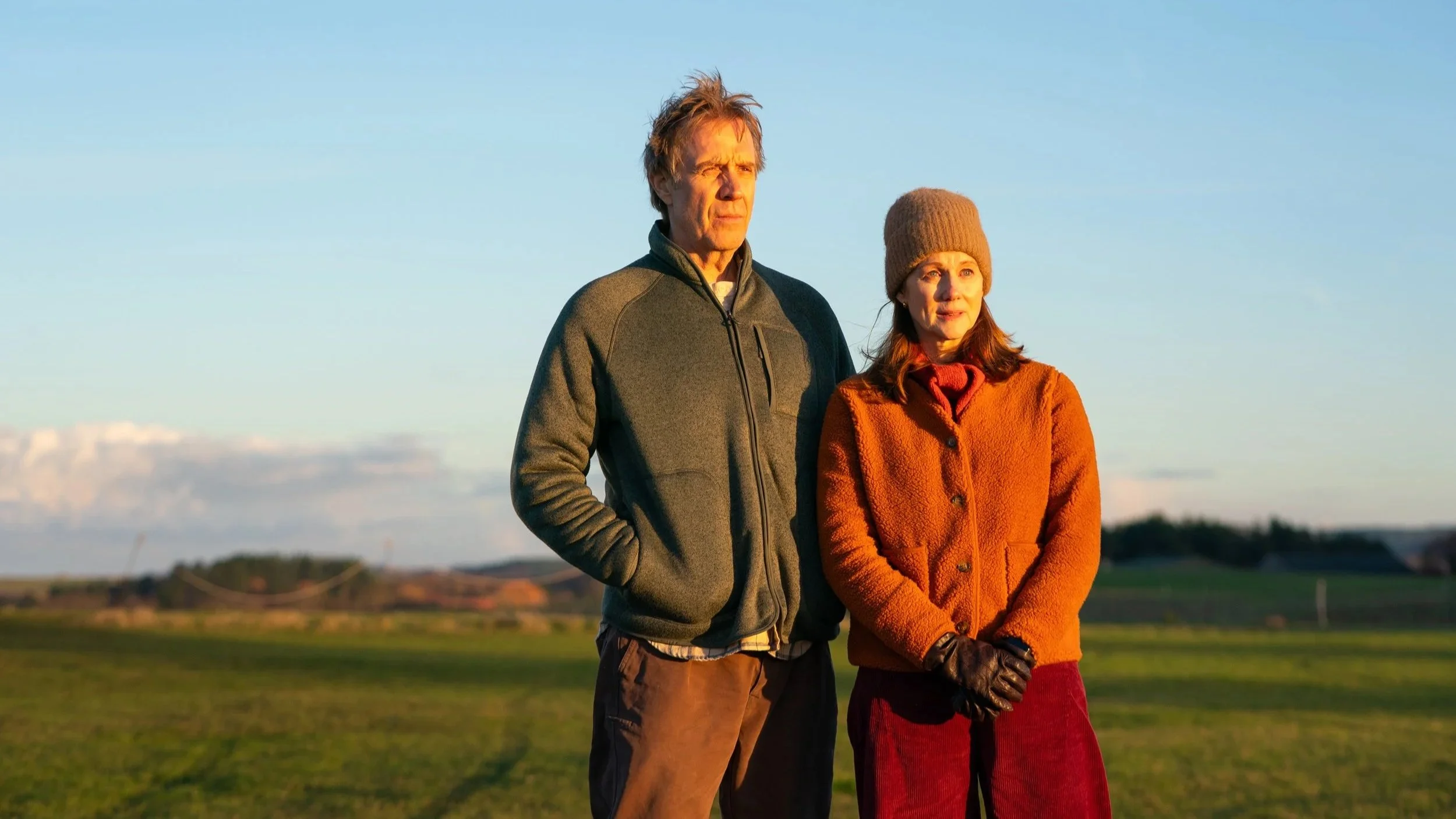
Rhys Ifans and Laura Linney in Onwards and Sideways (image: BBC/Jonathan Birch)
Given they have starred in two of the most beloved British films of all time, it’s hard to believe Laura Linney and Rhys Ifans haven’t worked together before – although they have both shared set space with Hugh Grant. When Popcorn Podcast sat down with the duo at Toronto International Film Festival to talk about their moving new film, Onwards and Sideways, the pair joke they have almost been in the same film and their Love Actually and Notting Hill characters could have easily wandered into each other’s stories. Linney plays a lovelorn American expat caring for her institutionalised brother in Love Actually, while Ifans is the chaotic roommate answering the door to press in his underwear in Notting Hill.
Their characters in Onwards and Sideways are a world away from those romantic classics, as Linney and Ifans play a composer and teacher, respectively, diagnosed with Parkinson’s disease on the same day. What follows is ‘five good years’ and the building of a sweet romance filled with compassion and challenges. The story is written and inspired by writer and actor Paul Mayhew-Archer’s (The Vicar of Dibley) experience of the disease. He also stars as the grizzly Tom, who provides a confronting look into their potential future, but delivers wise perspective.
Linney and Ifans both share how they mapped the physical markers of the disease’s progression when filming out of sequential order and the responsibility of representing a community of people with lived experience, some of whom were heavily involved in the production in front of and behind the camera.
“What bonded us almost immediately was cold fear,” Ifans tells Popcorn Podcast, describing it as “imposter syndrome on steroids”, while Linney admits she was “scared out of my mind” at the thought of getting it wrong.
They also reveal what lights up their own brains and the films that inspire them.
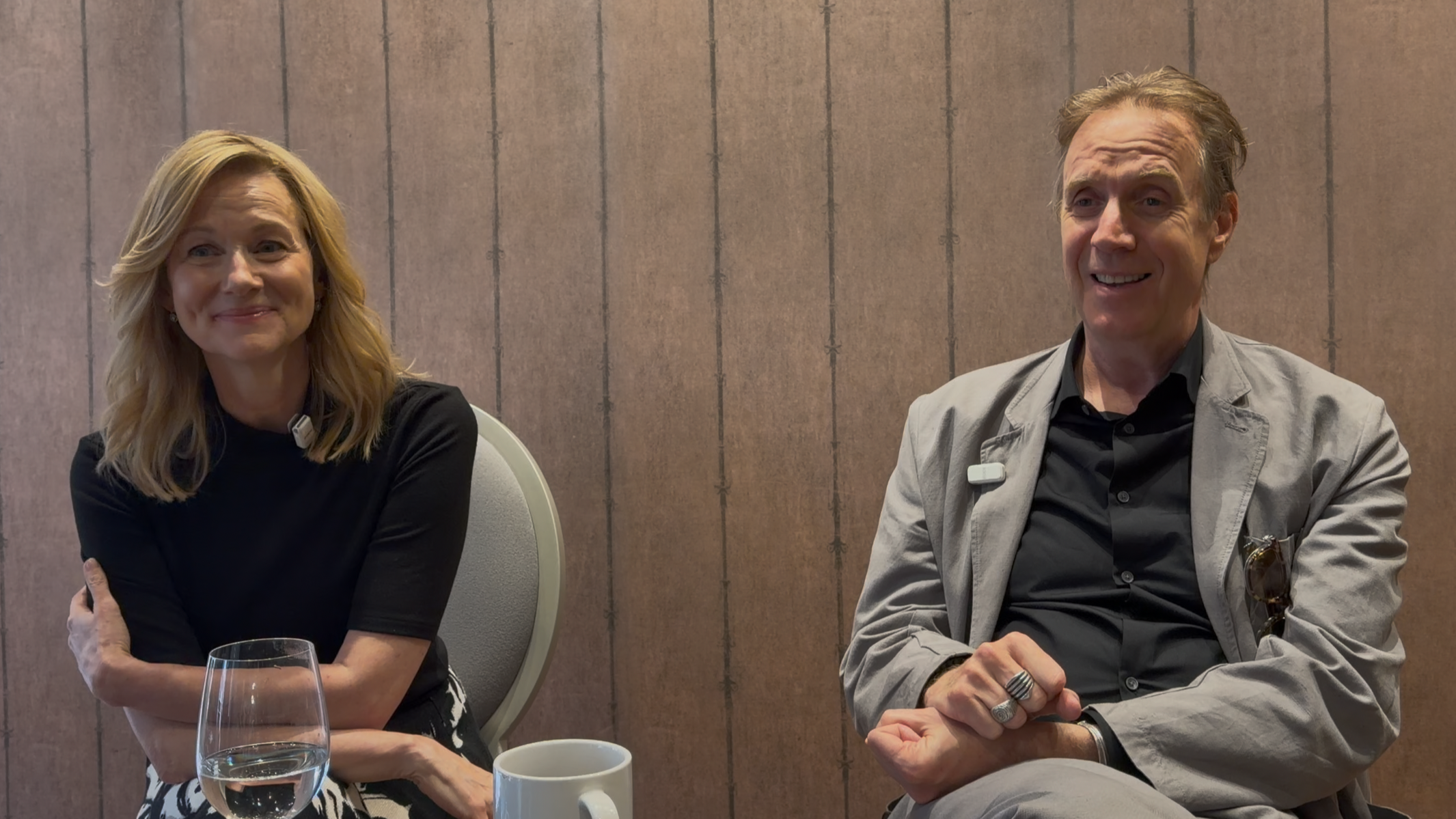
Laura Linney and Rhys Ifans speak with Popcorn Podcast at Toronto International Film Festival (TIFF)
Leigh Livingstone: How did you work together to build these wonderful characters? Is there anything special you did outside of filming or did you have rehearsals?
Rhys Ifans: Yeah, more than any other job I’ve ever done. You know, because we had the Parkinson’s component. So I think what bonded us almost immediately was cold fear. You know, having been brave and courageous and curious enough to say yes to this.
Laura Linney: Then came the reality. We have to do this.
RI: Realising that we were representing a worldwide demographic.
LL: You, know, there could be a very bad version of this movie.
LL: I like the way you use the words brave and curious because that seems to be the tone that Paul set with this story. It’s very uplifting, but also had me in floods of tears. Thank you for that, in the best way. Your writer and co-star Paul has Parkinson’s, as we know, but there were so many others involved in this film who did such a great job. This story comes from a very personal place. How does that responsibility feel as an actor, having this community of people being represented and them being so invested in seeing their experience? Does it make the job easier having them on the set?
LL: Having them on set… yes, absolutely. As far as the support and and also letting us know if we're off a little bit, we had two fantastic physiotherapists with us from Neuro Heroes who watched us every day to make sure that we were physically in the right world, and then our our magnificent ensemble of actors who have Parkinson’s were incredibly supportive and kind and incredibly inspiring. But it was nerve-wracking going into it. I mean, I was scared out of my mind, just because you think ‘Oh, can I do this in the way that it needs to be done? Can I do this in a in a way that is authentic, in a way that also tells the story, in a way that doesn't get in the way of of the work, in a way that won't mess up my co-star or anyone else?’
Rhys Ifans: Yeah, it’s imposter syndrome on steroids initially because you feel what right do I have? To put myself in the shoes of someone who lives with this condition day-by-day and for the rest of their entire life, you know? It's interesting
LL: It’s interesting that you say that imposter syndrome because you both have had such wonderfully varied career, I would think that would make you more brave to try…
RI: Well, it made us brave enough to say yes. Bravery and stupidity are very, you know, close bedfellows.
LL: What boxes does a project have to tick to get you both on board?
LL: For me, it has to have one of three things: a great director, a great script or a great co-star. If it’s two of those things, fantastic. If it’s three, it’s a slam dunk. So this had three.
RI: Well, I would say Laura Linney, Laura Linney. Wait a minute… Oh yeah, Laura Linny!
LL: The film tracks your characters across five years of the disease’s progression, but it was shot out of chronological order. So how did you keep track of which year you were playing on any given day? Were there physical markers?
LL: Oh, I nerded out. I had boards and graphs and cards and scripts open all the time, just to make sure that I was clear about where we were, so that it would have some sense of topography that made sense.
RI: I would just turn to the physiotherapist and go, ‘What am I doing? What am I doing now?’
LL: What year is this?
RI: Yeah, it was because in the in the space of a morning, we’d be tracking the disease’s progression over five years. Initially, the first couple of weeks it was challenging, but like anything, you get used to wearing the trousers or the shoes or the shirt required. We kind of arrived at it in a way, just in technical terms, like learning a dialect, but a physical one. Of course, dialect stays the same, but this was a dialect that evolved and changed at its core. Then we got used to it and it almost became second nature, didn't it? Not because we were getting better at it, because we were slowly becoming utterly consumed with the material and the emotional world of these characters. That became the the motor for the storytelling, as opposed to just getting something technically right.

LL: The scenes where Paul is yelling at his feet to f**king move, they bring some of the lighter moments to the darker aspects of the disease. But were there moments that didn't quite work or landed darker that you had to massage a bit, make a bit lighter throughout the film?
LL: I think that’s more a question for John, really. I think if we started to look at ourselves that way, I think we'd start limiting what we were doing.
LL: I love Emma’s whole focus about lighting up her brain. That’s really wonderful. What lights up your brains?
LL: Art. Art lights up my brain.
RI: I would say the same.
LL: And friendship, like connection.
LL: Laura, you’re an honorary Brit at this point…
RI: Honorary, Welsh now!
LL: Which of each other’s movies would you have loved to have been in?
RI: I want to be in all of Laura’s.
LL: Yeah, I mean, vice versa. We really lucked out…
RI: You know, we have the Love Actually Notting Hill cross.
LL: That’s right!
RI: We’ve almost been in the same film...
LL: We’ve almost done it…
LL: You both kind of worked with Hugh Grant.
RI: It’s quite tangible that Laura's character could have wandered into Notting Hill, and I could have wandered into Love Actually.
LL: That would have been good. You could have wandered in in your underwear…
RI: Well, yeah, of course.
LL: Both Emma and Tony are very gifted in their own things, but Emma’s not the best driver and Tony has trouble with confrontation. You’re both obviously incredibly gifted actors, but is there anything that you’re bad at that you would admit to?
LL: Oh, there's a tonne that I’m bad at. I’m not the greatest cook in the world. I can cook, but I’m a good baker. I'm a very good baker. But I get a little nervous in the kitchen.
RI: Mathematics.
LL: Oh God, forget it!
RI: I’m getting a rash now just thinking about numbers.
LL: I failed math in high school. I failed it.
RI: If I have to like work out dates on a calendar or how much I owe someone or what something’s going to cost or percentages and things like that, forget it.
LL: Before I let you go, we’re all about celebrating movies at Popcorn Podcast and how they impact us and how they bring us joy. What is a moment from any film that you’ve seen or worked on that has really stuck with you and brought you joy?
LL: Oh well, my favourite movie is Slap Shot and, oh, Paul Newman... it’s so good. It’s about a hockey team and that movie lights up my brain. I love it. I love the character development. I love the humour of it. I love the costume design. I’m in peals of laughter and delight. It’s Slap Shot for me.
LL: I love that. What about yourself, Rhys?
RI: I just watched a Spanish film, and I want to get this right, on Mubi. I think it's called The Summer of 1993. Have you seen it? Forgive me, I don’t remember the director’s name.
It’s about a little girl who loses her mother and then has to move to the country to live with her relatives in Spain, and it follows her over the period of a year or a bit more. It’s the best kind of observation of children at play. There’s two little girls in it who are just incredible and they live in this kind of bucolic Spanish hillside house, and it made me cry. Big, clumpy, happy drops of saltiness, and it was beautiful.
LL: That's the best thing about film, is how it can make us feel. Thank you for this beautiful film because it really made me feel.